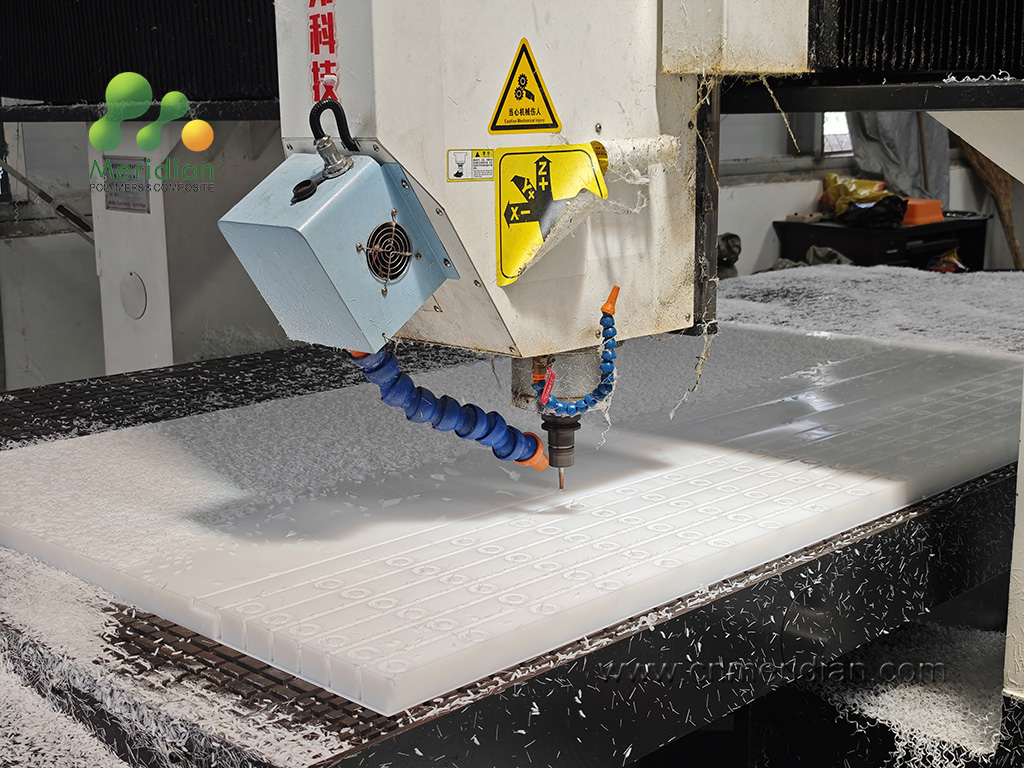
Machined plastic parts are precision components manufactured through subtractive processing methods, including CNC milling, turning, drilling, and threading. Instead of being molded, these parts are cut and shaped from solid plastic rods, sheets, or blocks. Machining offers excellent dimensional accuracy, surface finish, and design flexibility — making it ideal for low to medium production volumes, prototypes, or custom industrial components that require tight tolerances.
Compared with injection molding or extrusion, machining is especially suitable when:
Production quantities are small or varied.
The part requires complex geometry or post-processing, not feasible by molding.
The chosen material is difficult or expensive to mold (such as high-performance engineering plastics).
The design must integrate precisely with metal or rubber assemblies.
Machined plastic parts are widely used in various industries, including mechanical engineering, chemical processing, electronics, fluid control systems, and precision instruments. They can serve as bushings, wear plates, gears, insulators, housings, seals, and structural supports in industrial equipment.
| Plastic Material |
Key Strengths |
Considerations |
| POM (Acetal) |
Excellent machinability, good wear/dim stability |
Moderate cost; check chemical/temperature limits |
| Nylon |
Tough, good load capacity |
Moisture absorption; some shrinkage/instability |
| Acrylic (PMMA) |
Clear, good finish, aesthetic covers |
Lower mechanical strength; can be brittle |
| Polycarbonate (PC) |
Strong, impact-resistant, transparent options |
More heat management is needed in machining |
| UHMW-PE |
Very good wear/abrasion resistance, low friction |
Softer; machining may require special care for heat/deflection |
| High-Performance Plastics (PEEK, PPS, PSU) |
Top-tier mechanical/thermal/chemical performance |
Costly; higher machining challenge |